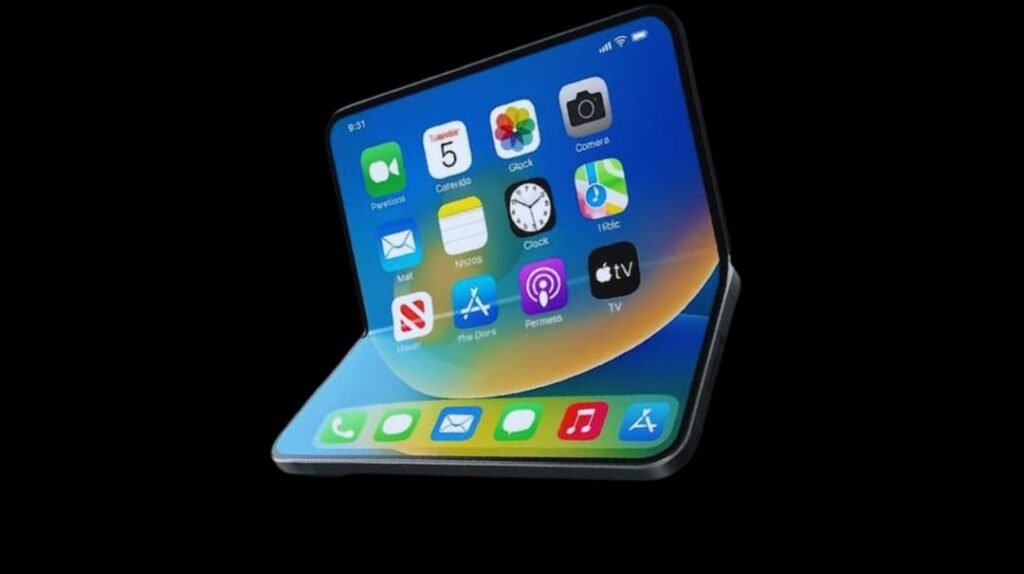
Apple’s foldable iPhone is currently in its early testing phase. The device is not final, but its details suggest a serious shift in Apple’s hardware strategy.
Reliable source Digital Chat Station recently revealed that the prototype features a 7.58-inch internal display. The resolution is 2713 × 1920 pixels. Its screen ratio is 14.1:10, closer to tablets than smartphones. The outer display also has a 14.6:10 ratio. This setup signals that Apple is blending portability with productivity.
Apple’s Foldable iPhone: Key Details
| Feature | Details |
|---|---|
| Internal Display | 7.58-inch, 2713 × 1920 pixels |
| Aspect Ratio | 14.1:10 inner, 14.6:10 outer |
| Cameras | Dual 48MP sensors |
| Camera Tech | Under-display cameras (no visible sensors) |
| Material | Titanium alloy body, amorphous metal glass hinge |
| Biometrics | Side-mounted Touch ID |
| Launch Window | Fall 2026 (alongside iPhone 18 series) |
| Mass Production Start | Q3–Q4 2025 |
| Panel Supplier | Samsung Display (7–8 million units) |
| Units Ordered by Apple | 15–20 million units |
| Source | MacRumors |
Screen Design: Beyond Smartphones
Apple’s foldable iPhone doesn’t mimic its competitors. The aspect ratio breaks away from the tall, narrow designs found in Samsung’s Galaxy Z Fold line. Instead, it favors a wider canvas. This makes the device resemble a compact tablet when unfolded. For multitasking, reading, and media, this could offer more real estate than any previous iPhone.
What’s notably missing from early renders are front-facing sensors. Apple may be pushing for under-display camera integration on both screens. That would result in a clean, uniform aesthetic across the device; no notch, no punch-hole. Still, this detail awaits final confirmation from Apple’s internal testing.
Materials and Build Quality
Durability is a key concern for foldables. Apple seems aware. The hinge is reportedly made using amorphous metal glass, a material chosen for its high strength and resistance to deformation. The chassis? Titanium alloy. This mirrors Apple’s recent move to titanium in the iPhone 15 Pro series, offering strength without weight.
Unlike recent iPhones, this model could feature a side-mounted Touch ID sensor. Apple hasn’t used this in years, favoring Face ID. But foldables bring challenges for facial recognition under different angles. A fingerprint sensor on the side may offer a more practical and reliable solution.
Camera System: Keeping Up with Pros
Apple equips this foldable iPhone with two 48MP cameras. These are expected to match the capabilities of the iPhone 15 Pro sensors. The company has recently placed heavy emphasis on mobile photography. This dual-camera setup suggests Apple won’t compromise on imaging performance, even with the foldable form factor.
Expect computational photography, ProRAW capabilities, and enhanced night mode performance; all packaged into a folding design. Apple could also use its image signal processing to boost low-light capture without adding bulk.
Timeline and Supply Chain
Ming-Chi Kuo, a long-time Apple analyst, has shared production estimates. Foxconn is expected to begin assembly in late 2025. Apple will likely unveil the product in fall 2026 alongside the iPhone 18 lineup. That gives the company time to refine the mechanics and software.
Samsung Display will reportedly supply around 7 to 8 million foldable panels for Apple in 2026. Apple plans to purchase 15 to 20 million units in total. Given the expected high cost of the device, these numbers suggest a multi-year sales cycle, much like early iPhone or iPad launches.
Apple appears cautious. Rather than chasing early market share, the company is taking its time to perfect the design. That aligns with its traditional approach: let rivals experiment, then launch a more polished alternative.
Market Impact and Pricing Expectations
The foldable iPhone will likely command a premium. With titanium, advanced hinge tech, under-display cameras, and high-res OLED panels, this device may surpass the iPhone Pro Max in cost. Pricing could easily start north of $1,800 or KES 230,000+ depending on storage options.
However, it won’t aim for mass adoption immediately. Apple seems to position this model as a new category; somewhere between an iPhone and an iPad mini. Professionals, digital creatives, and productivity-focused users might form the core target market.
If the foldable proves successful, we could see a whole new tier of iOS devices emerge.
Why Apple Took This Long
Foldables have been around since 2019. Samsung, Huawei, and others have several models in circulation. Apple’s delay isn’t due to lack of resources, it’s about timing. The company has waited for supply chains, software, and user demand to mature.
Battery life, hinge reliability, screen creases, and camera placement all posed design barriers. Now, with refinements in display tech and materials like amorphous metal glass, Apple sees a clearer path forward.
Moreover, iOS will need updates to support multi-screen layouts, flexible UI transitions, and tablet-like app scaling. These software changes may quietly appear in iOS 27 or 28, ahead of the device’s release.
Final Thoughts on the Foldable iPhone’s Future
Apple’s foldable iPhone is not just a bigger iPhone. It’s a rethinking of how a phone and tablet can merge. By leveraging titanium, custom hinge materials, under-display camera tech, and robust camera systems, Apple is designing a device that aims to last and lead.
We’re still over a year away from launch. But early specs show promise. Apple’s careful, calculated entry into foldables could once again set the standard for the entire mobile industry.