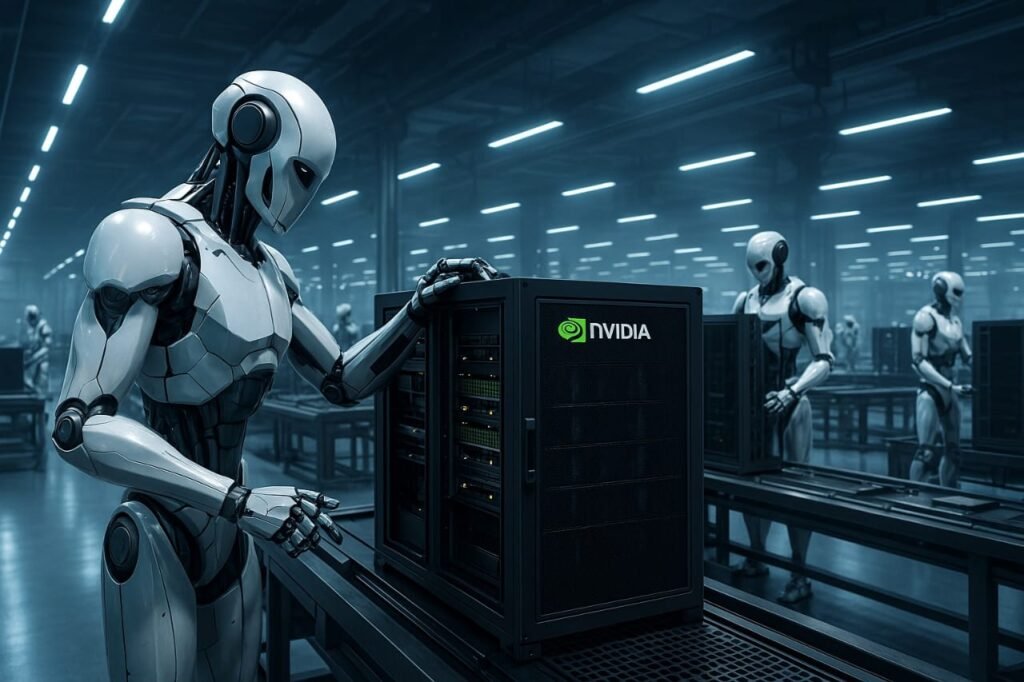
Houston, we have a revolution. In what’s shaping up to be one of the most controversial and visionary moves in modern industry, tech titans Foxconn and Nvidia are teaming up to open a futuristic robot-powered factory in Houston, Texas. Yes, you read that right: the machines aren’t coming. They’re already here.
Why Tech-Savvy Millennials Are Obsessed with This AI Factory Trend
Millennials, especially those steeped in the world of AI, automation, and future tech, are already buzzing about the implications. Think of it: a robot standing in a warehouse, calmly plugging in cables and lifting server racks, while sipping zero power drinks (okay, maybe not yet).
The allure lies in the sheer scale and audacity of the project. According to Reuters, the robots will handle tasks like:
- Inserting data cables with precision
- Assembling intricate AI server modules
- Transporting parts using mobile robotic platforms
This is no small leap. It’s a giant robotic stride toward what Nvidia CEO Jensen Huang claims will be the “new industrial normal” within five years.
The Unknowns: What Kind of Robots Are Coming?
So far, the project is shrouded in secrecy. We don’t know the robot models, how many will be deployed, or the suppliers. But hints have emerged. In the past, Foxconn tested humanoid robots from UBTech, a Chinese robotics company. Now, whispers suggest they’re developing the new bots directly with Nvidia.
A leaked source close to the project confirmed that two robot types are in development:
| Model Type | Mobility | Estimated Cost | Main Function |
|---|---|---|---|
| Wheeled Humanoid | Fast mobility, indoor use | Lower | Component assembly, cable management |
| Legged Humanoid | High agility, rugged terrain | Higher | Heavy lifting, warehouse logistics |
The factory location was chosen deliberately. Houston offers vast space, critical for robots that need maneuvering room. This isn’t your average conveyor belt setup. It’s more like a robotic ballet across a mega-factory floor.
Is This the End of Human Labor? Experts Weigh In
It’s not just Nvidia and Foxconn in this race. Mercedes-Benz, BMW, Tesla, and a swarm of Chinese manufacturers are funneling billions into humanoid robotics.
“Humanoid robots will become as common as forklifts in five years,” Jensen Huang boldly stated at a recent press event. But critics argue the flip side: what happens to the human workers being replaced?
“We’re not just replacing physical labor. We’re disrupting decades of social and economic structures,” says Laura Nguyen, a tech ethicist at MIT.
The news has drawn sharp commentary from labor unions and activists who see this as a slippery slope toward mass automation-induced unemployment. However, others argue this tech transition will create new jobs in AI development, maintenance, and robot oversight.
How the Rise of Robotic Factories Impacts You
Whether you’re an aspiring tech founder, a data center operator, or just curious about the future, this project is a wake-up call. It’s not sci-fi anymore. It’s real, tangible, and already under construction in the Lone Star State.
What you should know:
- Job roles are shifting – expect more demand for AI trainers, robot QA specialists, and remote factory ops engineers.
- Education systems will pivot – trade schools may soon offer “Robotics Ops” instead of “Auto Shop.”
- Investors are watching closely – Nvidia stock recently saw a bump following rumors of this automated factory.
Final Thought: Welcome to the Robot Age
Like it or not, the robotic workforce revolution is here. Foxconn and Nvidia’s Houston venture is the opening act in what could become a worldwide industrial transformation. As we race toward a future filled with android coworkers, the real question is: will we adapt fast enough, or be left behind?
One thing’s certain: the next time you hear the hum of a factory, it might not be from workers whistling, it might be from robots quietly assembling the future.