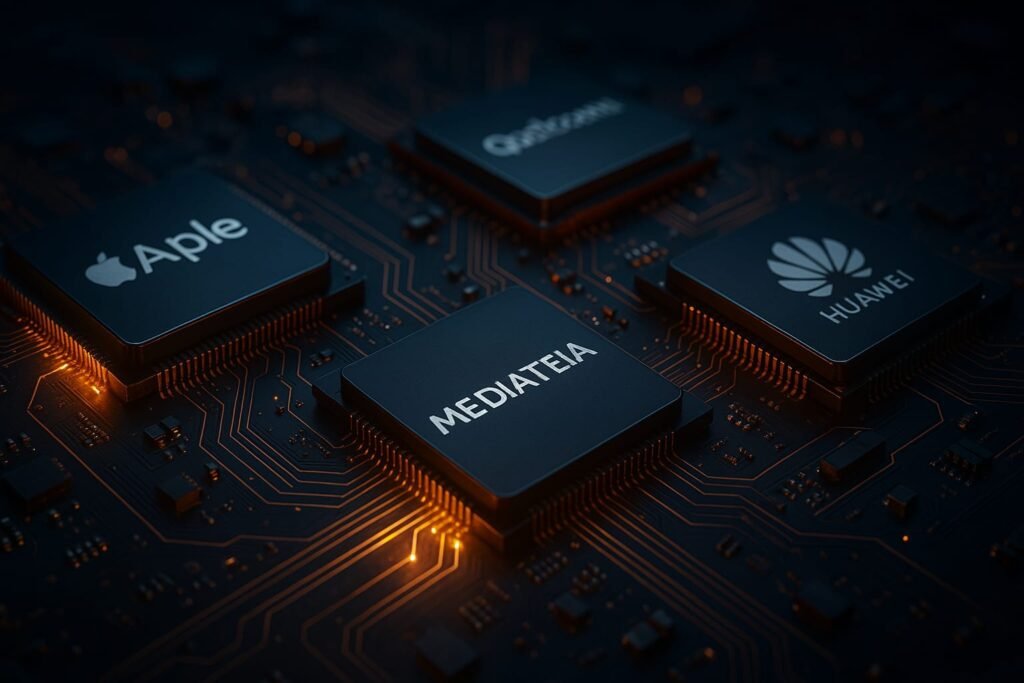
The battle for mobile silicon supremacy is reaching a critical point. As 2025 closes in, chipmakers; Apple, Qualcomm, MediaTek, and Huawei are preparing their most powerful SoCs yet. Each one is chasing top-tier performance, market control, and technological influence.
Apple’s A19 Pro chip will arrive first in September. It’s built on TSMC’s N3P process. It raises clock frequency and improves efficiency. Apple’s vertical integration ensures that this chip will work tightly with iOS and hardware. The A19 Pro is expected to lead performance benchmarks for the iPhone 17 lineup.
Qualcomm answers with the SM8850, likely named the Snapdragon 8 Elite 2. It launches the same month. Also using the N3P process, it promises record-breaking clock speeds and focused AI enhancements. Qualcomm is positioning it as the ultimate Android chip.
Comparative Table of Major Chipmakers and Their 2025 Flagship SoCs
| Chipmaker | Flagship SoC | Expected Launch | Manufacturing Node | Focus Area | Integration Strategy | Reference Link |
|---|---|---|---|---|---|---|
| Apple | A19 Pro | September 2025 | TSMC N3P | Power Efficiency, Integration | Fully Vertical | Apple Official |
| Qualcomm | Snapdragon 8 Elite 2 (SM8850) | September 2025 | TSMC N3P | Clock Speed, AI | Modular Android | Qualcomm Official |
| MediaTek | Dimensity 9500 | September 2025 | Likely TSMC N3 | Gaming, AI | Third-party Android | MediaTek Official |
| Huawei | Kirin 9030 | Late 2025 | Unknown (Possibly SMIC N5/N7) | Domestic Integration | In-House EMUI | Huawei Official |
MediaTek Moves Quietly but Strategically
MediaTek’s Dimensity 9500 hasn’t been revealed yet. Industry signals say it may arrive just before Qualcomm’s chip. Early specs hint at AI acceleration and gaming improvements. It’s MediaTek’s clearest attempt yet to stay relevant in the flagship space.
If MediaTek delivers in both performance and thermal control, it could pose a genuine challenge to Qualcomm’s dominance. By focusing on high-refresh-rate gaming, AI image processing, and efficient thermal scaling, MediaTek may gain OEM trust.
Huawei’s Kirin 9030: A Comeback on Principle
Huawei will reenter the premium chip space by late 2025 with the Kirin 9030. Little is known about this SoC. But analysts believe it may be based on advanced domestic foundry technology. Huawei likely wants to reduce reliance on foreign IPs and regain market presence in China.
The Kirin 9030 might not beat Apple or Qualcomm on raw numbers. But Huawei’s goal could be internal ecosystem resilience. The chip is not just about specs, it’s a statement.
Xiaomi’s Surprise Player: The Xring O1
In a plot twist, Xiaomi’s in-house chip, the Xring O1 drew praise across tech circles. Though made in low volume, its strong performance raised eyebrows. Lei Jun, Xiaomi’s CEO, admitted the response was unexpected:
“We didn’t expect O1 to perform so well. Production was limited at first, but we’ll aim for greater volume with the next generation.”
If Xiaomi scales its next chip, it could join the main chipmakers at the table. This suggests a shift: in-house design is no longer optional, it’s strategic.
The Clock Speed Race
Performance in 2025 won’t just be about transistor counts. Clock speed is king again. Qualcomm leads in pushing limits, aiming for speeds above 3.7 GHz on mobile SoCs. Apple, while quieter, uses silicon efficiency and tight OS integration for sustained speeds.
Thermal envelopes are tight. Battery size hasn’t changed, so efficiency matters more than ever. Every chipmaker is optimizing for peak-per-watt ratios.
AI Is the Next Frontier
Each chip will now feature a dedicated AI processing unit. Qualcomm calls it the AI Engine, Apple integrates Neural Engine, and MediaTek has its APU (AI Processing Unit). These cores handle voice commands, image post-processing, and predictive text locally, no cloud needed.
Mobile chips are no longer just CPUs. They are multi-core AI systems on a palm-sized die.
Volume, Timing, and Supply Chain Now Matter More Than Ever
It’s no longer enough to build the best chip. It must be ready on time. It must scale.
Apple has the supply chain. Qualcomm relies on OEM demand. MediaTek juggles both. Huawei fights sanctions and limited silicon access. Xiaomi enters the volume game cautiously.
The new rules of competition in the chipmaker world are clear:
- Deliver early
- Deliver in volume
- Deliver consistently


